 EV Risk Index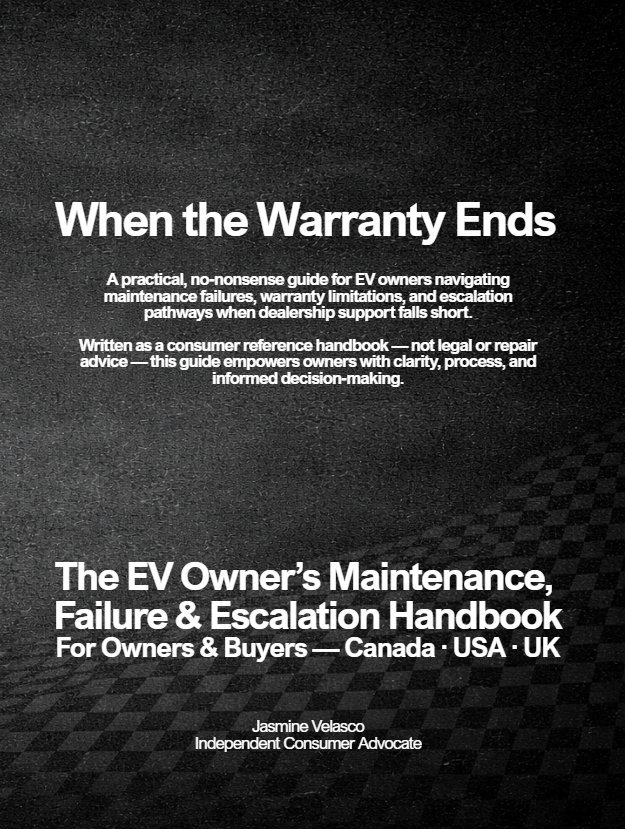
When the Warranty Ends
A 247-page practical consumer handbook for electric vehicle owners facing maintenance failures, warranty limitations, and unresolved dealership support. Covers 24+ specific EV models across Canada, USA, and UK — plus universal escalation templates that work for any electric vehicle.
What you'll learn inside this guide
Electric vehicles promise innovation, efficiency, and lower operating costs — but when problems arise after the warranty expires, many owners discover how complex, expensive, and confusing EV ownership can become. From sudden shutdowns and charging failures to software faults and unresolved dealership repairs, navigating next steps often feels overwhelming. This handbook is designed to change that.
- Identify common EV failures and early warning signs before they escalate
- Document mechanical, software, and drivability issues correctly for manufacturer escalation
- Navigate repairs both under and outside of warranty, with realistic cost expectations
- Escalate unresolved issues to manufacturers and regulators (NHTSA, Transport Canada, DVSA)
- Understand consumer rights in Canada, the United States, and the United Kingdom
- Make informed decisions about repair, escalation, trade-in, or exit strategies
What to do when your EV warranty is denied
Warranty denial is one of the most common escalation points for electric vehicle owners — and one of the least understood. Whether the issue involves battery degradation, software faults, charging failures, or intermittent drivability problems, manufacturers and dealerships often rely on narrow interpretations of warranty coverage.
When a warranty claim is denied, the outcome is rarely final. What matters is how the issue has been documented, how the failure has been described, and whether the problem has been framed as a usability issue or a potential safety concern. Owners who maintain clear service records, written timelines, and consistent terminology are significantly more effective in escalation scenarios.
This guide explains how to move from a rejected claim to a structured escalation — including how to communicate with dealership service managers, manufacturer corporate teams, and regulatory bodies when required.
For model-specific reliability patterns and known issues that frequently appear in warranty disputes, see the EV Risk Index vehicle database, which tracks failure trends across 88 electric vehicles.
Real EV repair costs after warranty
One of the least transparent aspects of electric vehicle ownership is the cost of repairs once warranty coverage ends. While EVs have fewer moving parts than internal combustion vehicles, certain components — particularly battery systems and electronic control units — can be expensive when they fail outside warranty protection.
Battery replacement costs can range from several thousand dollars for modular repairs to significantly higher figures for full pack replacement. Other common out-of-warranty costs include onboard chargers, power electronics, thermal management systems, and software-related diagnostics that require manufacturer-level access.
Understanding these costs is not about predicting failure — it is about making informed decisions when a failure occurs. Repair, escalation, trade-in, or exit strategies all depend on realistic cost expectations rather than assumptions about EV reliability.
You can compare long-term reliability signals across 88 EV models — including battery systems, known failure patterns, and ownership risk indicators — in the EV Risk Index database.
How to escalate a complaint to a manufacturer or regulator
When dealership-level resolution fails, escalation to the manufacturer or a regulatory body becomes necessary. Most EV owners are unaware that formal complaint systems exist — and that these systems can directly influence how manufacturers respond to unresolved issues.
In the United States, safety-related concerns can be reported through the National Highway Traffic Safety Administration (NHTSA). In Canada, Transport Canada provides a similar defect reporting system. In the United Kingdom, the Driver and Vehicle Standards Agency (DVSA) handles safety investigations and recalls.
Effective escalation requires structured documentation, consistent terminology, and a clear explanation of how the issue affects vehicle safety, usability, or reliability. This guide outlines how to prepare that documentation and how to approach escalation in a way that increases the likelihood of meaningful response.
Real-world recall activity and manufacturer responses for tracked vehicles can be reviewed in our recall tracking section, which aggregates regulator-reported campaigns and remedy status across NHTSA and DVSA.
Most common electric vehicle failures owners report
While electric vehicles eliminate many traditional mechanical issues, they introduce a different category of failures — often centered around software, battery systems, and integrated electronics. These issues can be difficult to diagnose and, in some cases, difficult for dealerships to resolve efficiently.
Commonly reported problems include charging failures, unexpected range loss, battery management system errors, software instability, and intermittent power delivery issues. Some failures are resolved through updates or component replacement, while others persist across multiple service visits.
Recognizing patterns in these failures is important. It allows owners to distinguish between isolated incidents and systemic issues affecting specific models or production years. That distinction often determines whether a situation should be treated as a routine repair — or escalated as part of a broader reliability concern.
These patterns are reflected across the vehicles tracked by EV Risk Index, where model-specific risks and recurring issues are scored on a 0–100 failure index updated as new regulatory data emerges.
Vehicles covered in dedicated chapters
Part III of the book (Chapters 21–44) provides owner-reported failure analysis and real-world cost reality for each of these 24 electric vehicles. Each chapter runs 3–5 pages and covers known failure patterns, warranty behavior, typical repair costs, and escalation guidance specific to that model.
Premium & Performance
- Jaguar I-PACECh. 21
- Porsche TaycanCh. 44
- BMW i4 & BMW iXCh. 38
- Audi Q8 e-tron & e-tron GTCh. 39
- Cadillac LYRIQCh. 30
- Cadillac Escalade IQCh. 31
- Dodge Charger Daytona EVCh. 37
- Acura ZDXCh. 43
- Lexus RZCh. 40
Tesla
- Tesla Model 3Ch. 22
- Tesla Model YCh. 23
- Tesla Model SCh. 24
Ford & General Motors
- Ford Mustang Mach-ECh. 25
- Chevrolet Bolt EV & EUVCh. 26
- Chevrolet Blazer EVCh. 27
- Chevrolet Equinox EVCh. 28
- Chevrolet Silverado EVCh. 29
Hyundai & Kia
- Hyundai Kona ElectricCh. 32
- Hyundai IONIQ 5Ch. 33
- Kia EV6Ch. 34
- Kia Niro EVCh. 35
European & Japanese
- Volkswagen ID.4Ch. 36
- Toyota bZ4XCh. 41
- Nissan LEAF & AriyaCh. 42
Don't see your vehicle? The templates work anyway.
The escalation frameworks, letter and email templates, consumer-rights chapters, safety-defect reporting procedures, and manufacturer contact directory in Chapters 10–19 are universal. Whether you drive a Rivian R1T, Polestar 2, BYD Seal, Volvo EX90, Lucid Air, or any other EV not listed above, the processes, documentation strategies, and legal frameworks work the same way. The book's value is the process knowledge, not just the model-specific chapters.

Frequently asked questions
Does this book cover my specific electric vehicle?
The book has dedicated chapters for 24 specific EV models: the Jaguar I-PACE, Tesla Model 3/Y/S, Ford Mustang Mach-E, Chevrolet Bolt EV/EUV, Blazer EV, Equinox EV and Silverado EV, Cadillac LYRIQ and Escalade IQ, Hyundai Kona Electric and IONIQ 5, Kia EV6 and Niro EV, Volkswagen ID.4, Dodge Charger Daytona EV, BMW i4 and iX, Audi Q8 e-tron and e-tron GT, Lexus RZ, Toyota bZ4X, Nissan LEAF and Ariya, Acura ZDX, and Porsche Taycan.
If your vehicle is not on that list, the universal sections of the book — escalation frameworks, consumer-rights chapters, safety-defect reporting procedures, and the templates-and-AI-tools chapter — apply to any electric vehicle brand or model. The book's value is in the process, not just the model-specific chapters.
Is this book legal advice?
No. When the Warranty Ends is an independent consumer reference handbook. It is not legal advice and not a repair manual. For specific legal situations, readers should consult a licensed attorney in their jurisdiction. For repairs, readers should consult certified technicians and follow manufacturer guidance.
The book provides process knowledge, documentation frameworks, terminology, and escalation pathways — the things most EV owners don't know exist until they need them and can't find them anywhere else.
What jurisdictions does the book cover?
The book covers consumer rights and escalation procedures for three primary jurisdictions:
Canada — including a dedicated Québec chapter on the Legal Warranty of Quality and Durability (which provides stronger protections than provincial consumer-protection frameworks in other provinces).
United States — federal NHTSA procedures for safety-defect reporting plus a review of state-level consumer protection frameworks and lemon-law variations.
United Kingdom — DVSA recall procedures and UK Consumer Rights Act 2015 protections including the six-month reverse burden of proof for defects.
What's the difference between this book and a repair manual?
A repair manual tells you how to fix a car mechanically. When the Warranty Ends tells you how to navigate the process when your car fails, your warranty doesn't cover it, or your dealer won't help.
It focuses on documentation, escalation pathways, consumer rights, manufacturer contact procedures, and strategic decision-making — the parts of EV ownership that no service manual covers. If you want to replace a battery module yourself, this is not that book. If you want to understand why your dealer is refusing to replace it and what to do about it, this is that book.
Are the templates useful for vehicles not listed in the book?
Yes. Chapters 10–19 provide universal escalation frameworks that apply to any electric vehicle:
- Corporate escalation contacts by brand and region (Chapter 11)
- Safety-defect reporting procedures for NHTSA, Transport Canada, and DVSA (Chapter 16)
- Consumer-rights chapters covering all three jurisdictions (Chapters 17–18)
- A templates-and-AI-tools chapter with letter and email formats, QR prompts, and documentation frameworks (Chapter 19)
These tools work regardless of whether your specific EV has a dedicated chapter in the book. A Rivian R1T owner or Polestar 2 owner gets just as much value from the escalation framework as a Tesla Model Y owner whose vehicle has its own chapter.
How long is the book?
247 pages, organized into four parts and 57 chapters:
- Part I (Chapters 1–9) — When your EV fails: failure patterns, warranty mechanics, dealer dynamics
- Part II (Chapters 10–19) — Escalation, rights, and safety: universal frameworks that work for any EV
- Part III (Chapters 20–44) — Model-specific reality checks: 24 dedicated chapters on the EVs most owners buy
- Part IV (Chapters 45–57) — Cost, risk, and ownership strategy: repair vs escalate vs trade vs exit decisions
Who should read When the Warranty Ends?
Current EV owners facing unresolved vehicle problems, prospective EV buyers researching long-term ownership risks, consumers considering out-of-warranty EV purchases, and anyone navigating a dispute with an EV manufacturer or dealership. The book is written for non-technical readers but provides enough terminology and process detail to be useful even to professionals — consumer advocates, dealer-service managers, and automotive journalists have found the escalation frameworks and jurisdictional comparisons particularly useful.
How does this relate to EV Risk Index?
EV Risk Index is the free online publication maintained by the same author, covering 88 EV models with risk scores, recall tracking, and ownership guidance. When the Warranty Ends is a longer-form reference document that goes deeper into the process knowledge — escalation frameworks, consumer rights chapters, and cost strategy — that doesn't fit neatly into individual vehicle pages. The book complements the site rather than duplicating it.
Move forward with clarity, confidence, and control.
Whether you're currently dealing with a serious vehicle issue, researching long-term EV ownership risks, or considering the purchase of an electric vehicle — When the Warranty Ends gives you the process knowledge most EV owners only discover the hard way.
Buy on Amazon ↗