 EV Risk Index
EV Warranty Denied — What to Do When Your Electric Vehicle Claim Is Refused
A denial from a dealership is rarely the final word. This guide explains how to understand the denial, how to document the dispute, how to escalate beyond the service department, and how to think about repair costs if the claim ultimately stands — covering the regulatory pathways available in Canada, the United States, and the United Kingdom.
If you have arrived at this page, your electric vehicle likely has a problem that the dealership has refused to fix under warranty. This is a frustrating and often financially alarming situation. The first thing to understand is that warranty denials from a dealership service department are rarely final. Most EV warranty disputes resolve not through lawsuits or arbitration but through a structured escalation process that begins with better documentation and ends with manufacturer corporate relations or, where safety is implicated, a defect report to the relevant national regulator.
This guide is not legal advice. It does not replace a conversation with a qualified attorney or a licensed mechanic for your specific situation. What it does is explain the procedural landscape: what manufacturers' warranties typically cover, why claims get denied, how to document your dispute effectively, and what escalation pathways exist if dealership-level resolution fails.
Quick summary
- A warranty denial from a dealership service department is rarely the final word on coverage.
- Most EV warranty disputes resolve through manufacturer corporate escalation, not litigation.
- Documentation quality — written denial reasons, diagnostic codes, service records — determines the quality of every outcome that follows.
- If the issue has safety implications, a defect complaint to the national regulator (NHTSA in the US, Transport Canada, DVSA in the UK) adds to the public record regardless of warranty outcome.
- Out-of-warranty repair cost varies by component type, repair depth, and parts availability; multiple written estimates are the only reliable way to know a fair price.
Why EV warranty claims get denied (most common reasons)
EV battery warranties are fundamentally different from bumper-to-bumper or powertrain coverage. According to Kelley Blue Book's 2025 guidance, federal law in the United States requires automakers to warrant EV and hybrid batteries for at least eight years or 100,000 miles, whichever comes first. California's CARB regulations tighten this further for 2026 model years, requiring batteries to retain at least 70 percent of their range for 10 years or 150,000 miles. But within those floors, manufacturers write their own specific language — and that specific language is where most denials live.
The most frequently reported denial reasons cluster around six patterns:
- Normal degradation, not a defect. Most warranties cover capacity loss only if it falls below a stated threshold (typically 70 percent of original capacity). Capacity that has degraded to 72 or 75 percent is generally considered normal wear and not covered.
- Aftermarket modifications or unauthorized software changes. Altering charging equipment, jailbreaking infotainment, or installing non-approved components can void coverage for related systems.
- Failure to follow the manufacturer's maintenance schedule. EVs have fewer service requirements than combustion vehicles, but skipped cooling system inspections, missed software updates, or improper tire rotations can be cited as grounds for denial.
- Use outside defined operating conditions. Extreme-cold operation, frequent full-depth discharges, or regular DC fast charging above the manufacturer's stated limits may be excluded — although, as Recharged's 2026 warranty guide notes, normal DC fast charging within manufacturer specifications generally does not void coverage.
- External damage attributed to the problem. Rodent damage to high-voltage wiring, road debris impact on battery enclosures, or flood exposure can shift responsibility from the manufacturer to the owner's insurance.
- The problem is classified as a component failure not covered under the battery warranty specifically. The high-voltage battery warranty and the drive unit warranty are sometimes separate. A failed onboard charger may fall under bumper-to-bumper coverage rather than battery coverage, with different term limits.
Patterns of warranty denial often cluster around specific models and production years. The EV Risk Index vehicle database tracks documented failure patterns across 88 electric vehicles, which can help you understand whether your issue appears to be isolated or part of a broader trend being reported by other owners.
Documenting the dispute properly
Whatever escalation path you pursue — corporate relations, regulator complaint, small claims court, or arbitration — the quality of your documentation determines the quality of the outcome. Strong documentation includes:
- The original purchase agreement and warranty booklet for the vehicle, showing the in-service date from which warranty coverage is measured.
- Every service record for the vehicle, including dealership visits for unrelated issues. Warranty denial sometimes hinges on whether a problem was previously reported; a service ticket from 18 months ago can change the outcome.
- Diagnostic trouble codes (DTCs) and any capacity measurements the dealership has recorded. Ask for a printout or photo of the diagnostic screen.
- A clear timeline of the symptoms: when they started, how frequently they occur, what conditions trigger them, whether they have worsened, and whether they affect safety (reduced power, unexpected shutdown, warning lights).
- Any manufacturer correspondence, including the original sales paperwork, any technical service bulletins (TSBs) you have been provided, and any prior communications about the issue.
- Independent diagnostic opinions where available. Some EV-specialist independent technicians can perform battery capacity analysis using manufacturer-compatible tools. An independent assessment disagreeing with the dealership's diagnosis is a powerful document during corporate escalation.
When describing the problem in writing — whether to corporate relations, a regulator, or an attorney — focus on observable facts rather than emotional framing. As Consumer Reports' guidance on writing NHTSA complaints notes: don't craft a narrative, focus on the incident. Describe what happened, what you observed, what was logged in diagnostics, and what the safety implications are (if any). Neutral, specific, factual reporting is what makes documentation useful at every level of escalation.
What to do if a dealership refuses to fix your EV
Most EV owners do not realize that dealership service departments and manufacturer corporate relations are different parts of the same company with different authority levels. A dealership technician operates within narrow warranty-interpretation guidelines set by the manufacturer. Corporate consumer relations has broader discretion to approve "goodwill" repairs, authorize re-inspection, or apply warranty coverage that the dealership declined.
Step 1: Manufacturer corporate consumer relations
Every major manufacturer operates a dedicated consumer relations line separate from dealership service. These numbers are listed in your warranty booklet and on the manufacturer's website. When you call:
- State clearly that you are escalating a warranty denial from a specific dealership.
- Reference your VIN and the dealership's case or RO (repair order) number.
- Request a case number for the escalation itself.
- Ask for the escalation timeline — how many days until you should expect a response.
- Follow up every correspondence with a written summary email to the case representative.
Corporate relations teams resolve more disputes than most owners expect. Goodwill repairs and "one-time assistance" authorizations are common outcomes, particularly when documentation is strong and the problem is well-known for the model.
Step 2: Independent diagnostic assessment
If corporate relations upholds the denial, a second diagnostic opinion from a qualified independent EV technician can change the picture. Battery capacity measurements, error code readouts, and component-level diagnostics performed by a technician not employed by the dealership create a document that carries weight in subsequent escalations. Some independent technicians use the same OEM-compatible tools the dealerships use; others use aftermarket diagnostic platforms. Either can produce usable documentation.
Step 3: Defect complaint to the national regulator
If the issue has safety implications — unexpected power loss, inability to start or charge, thermal events, battery management system failures causing reduced power warnings — a defect complaint to the relevant national regulator is appropriate regardless of whether the manufacturer ultimately approves the repair. The regulatory report does two things: it adds to the public record that shapes future investigations, and it signals to the manufacturer that the issue has been formally documented outside their control.
Similar defect-reporting processes exist in other jurisdictions including the European Union (through EU Safety Gate and national market surveillance authorities), Germany (Kraftfahrt-Bundesamt or KBA), and France (Rappel Conso). The escalation principles below apply globally; consult your national regulator for specific procedures outside the three jurisdictions detailed here.
How to file a defect complaint
These are the primary national regulators for Canada, the United States, and the United Kingdom. All three accept complaints directly from vehicle owners without requiring an attorney. Complaints are added to the regulator's public database and contribute to the pattern analysis that can trigger formal investigations.
- United States NHTSA Vehicle Owner's Questionnaire — file online at nhtsa.gov/report-a-safety-problem or by phone at 888-327-4236. Complaints are reviewed and added to the public database at nhtsa.gov/recalls.
- Canada Transport Canada Defect Investigations and Recalls Division — online defect complaint form at tc.canada.ca, or by phone at 1-800-333-0510. Telephone service runs Monday to Friday, 8:30 a.m. to 4:30 p.m. Eastern Time.
- United Kingdom Driver and Vehicle Standards Agency (DVSA) — safety concerns can be reported through gov.uk. DVSA also coordinates with manufacturers on UK vehicle recalls and consumer safety investigations.
When you file a regulator complaint, describe the issue factually, include your VIN, note any diagnostic codes, describe the dealership's response, and attach any written denial you have received. A single complaint alone rarely triggers a recall; patterns of similar complaints do. Your report contributes to that pattern analysis even if nothing happens immediately.
Some issues that begin as individual warranty disputes turn out to be documented defects already under regulator investigation or subject to formal recall. Our active recall tracking aggregates current safety campaigns across NHTSA and DVSA — worth checking by VIN before assuming your case is unique.
How much does it cost to repair an EV after warranty?
If every escalation path fails and the repair falls to you, the question becomes: what does this repair actually cost, and how do I estimate it fairly?
Rather than publishing specific dollar figures that vary wildly by vehicle, region, labor rates, and parts availability, the more defensible approach is to understand the methodology for estimating a repair. Three factors shape out-of-warranty EV repair cost:
Component type and scope
EV repairs fall into three broad cost tiers. Minor electronic components (onboard chargers, 12V auxiliary batteries, charging port assemblies, individual sensors) sit at the low end. Mid-range failures include drive unit components, inverters, power electronics modules, and thermal management system parts. The high end is battery pack work — module replacement, full-pack replacement, or BMS (battery management system) replacement.
Understand which tier your failure sits in by asking the service provider for a specific part name and number, not just a general description. "Battery issue" spans a $600 12V battery and a $20,000+ traction pack replacement.
Repair vs. replace vs. remanufacture
Many EV failures can be addressed at multiple depths. A battery pack with a single bad module can often be repaired by replacing the affected module — costing a fraction of a full-pack replacement. An inverter failure can sometimes be addressed by a remanufactured unit rather than new. An independent EV specialist may offer options that the dealership will not.
Ask specifically: is module-level repair available? Is a remanufactured part available? What is the warranty on each option? Does the repair require manufacturer-only access (service mode, authentication keys) that independent shops do not have?
Labor rates and parts availability
EV-qualified labor rates in major metropolitan areas typically run higher than non-EV vehicle labor, partly because high-voltage work requires specific training and insurance. Parts availability varies dramatically — some components are readily stocked; others require months of lead time, during which the vehicle is undrivable. Ask for an itemized estimate showing parts cost, labor hours, and labor rate separately, and ask for the expected lead time on parts.
Get multiple estimates where possible. A dealership quote for a battery module replacement can differ materially from an independent EV specialist quote, and both can differ from a manufacturer-authorized refurbishment program estimate. Getting three written estimates takes time but is the only way to know whether you are paying a fair price.
Whether a major repair makes financial sense also depends on the vehicle's broader reliability profile. Our vehicle database shows documented failure patterns and ownership risk indicators across 88 EV models, which can provide context on whether similar failures are commonly reported in the same model and year.
When to consider strategic alternatives
If the repair cost approaches the vehicle's market value, continuing to repair may not be the best decision. Four strategic alternatives are worth evaluating:
- Trade-in at current condition. Dealerships sometimes accept non-functioning EVs at wholesale auction prices. The trade value is often lower than owners expect, but it avoids continued carrying costs on a broken vehicle.
- Private sale with full disclosure. Selling a broken EV with complete disclosure of the fault to a buyer who wants to repair it themselves (or parts-out the vehicle) can sometimes yield more than dealer trade-in.
- Refurbishment through a third-party program. A growing number of independent EV specialists offer battery refurbishment at costs below OEM full-pack replacement. Quality and warranty terms vary significantly; research carefully.
- Continuing to drive the vehicle with the fault. Some EV failures (degraded range, specific feature loss) do not immediately render the vehicle undrivable. If the car still serves its primary purpose, continuing to drive while saving for repair or replacement may be the rational choice.
What to do right now
- Get the denial in writing from the dealership, with the specific clause cited and the diagnostic codes recorded.
- Collect your service records, warranty booklet, and VIN-specific warranty status from the manufacturer website.
- Call manufacturer corporate consumer relations and open a case. Get a case number.
- If the issue has any safety implication, file a defect complaint with NHTSA, Transport Canada, or DVSA depending on your jurisdiction.
- If the denial stands, request three written repair estimates before authorizing any work.
- If you plan a strategic alternative (trade, sale, refurbishment), get estimates on each option before deciding.
Deep-dive reference
For detailed escalation templates, corporate contact directories by brand and region, jurisdictional consumer-rights chapters, and 24 model-specific reality checks, see our companion guide When the Warranty Ends — a 247-page practical handbook for EV owners.
Read the guide →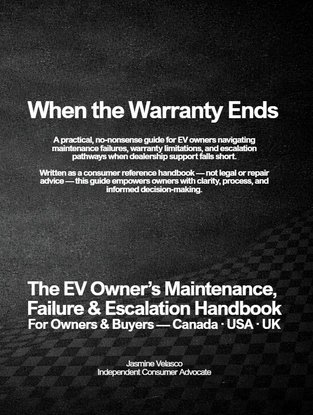
Warranty and regulatory information in this guide draws on publicly available sources including Kelley Blue Book's EV warranty coverage guidance (updated 2025), Recharged's 2026 EV battery warranty analysis, Endurance Warranty's 2026 EV warranty practical guide, Consumer Reports' guidance on NHTSA complaint procedure, and the NHTSA, Transport Canada, and DVSA official regulator pages. Specific figures mentioned (federal 8-year/100,000-mile minimums, CARB 2026 capacity thresholds, regulator contact numbers) were verified against official sources as of April 2026. This page will be updated as regulations evolve. This is not legal advice and not a repair manual. Readers should consult licensed professionals for situation-specific guidance.