 EV Risk Index
2019 Jaguar I-PACE
The 2019 Jaguar I-PACE scores 85/100 on our failure index — critical risk. 14 recall campaigns on file for the I-PACE, 9 covering the 2019 model year. Known issues: Thermal recall campaigns 2020-2024, persistent post-recall charging limits.
Featured in the book. This vehicle has a dedicated chapter in When the Warranty Ends — a 247-page EV owner's guide covering warranty denials, repair costs, and manufacturer escalation across Canada, USA, and UK.

Illustrative silhouette — not the actual vehicle
DiscontinuedLearn more · find one used
Discontinued after the 2024 model year
According to NHTSA filings (campaign 24V-633), Jaguar Land Rover announced a repurchase program for affected 2019 I-PACE vehicles. An interim software remedy caps state-of-charge at 80% pending completion of the repurchase process. Owners should verify their VIN with NHTSA and contact Jaguar customer service at 1-800-452-4827.
Links provided for reader convenience. EV Risk Index earns no referral revenue from these destinations. Silhouette color reflects the vehicle's risk-index band.
- Failure index
- 85/100 (Critical risk)
- Segment
- SUV
- Battery
- 90 kWh · NMC
- Battery supplier
- LG Chem
- Range (WLTP/EPA est.)
- 380 km
- Fast charging
- 100 kW
- Drivetrain
- AWD
- Region
- Global
- 5-year degradation (est.)
- 25%
Known issues for the 2019 model year
Thermal recall campaigns 2020-2024, persistent post-recall charging limits
Diagnostic code reference
Reading codes off a Jaguar I-PACE service invoice? Look them up in our OBD-II DTC database →
Service playbooks for this vehicle
- thermal management failure (2019–2023) high severity
Related symptom / evidence videos

Jaguar I-PACE H441 battery thermal recall explained
External owner-oriented explanation of the Jaguar I-PACE H441 thermal recall. EVRI provides this as recall-context evidence only; it is not diagnostic, legal, warranty, or repair instruction.

Jaguar I-PACE traction battery failure: diagnosis and independent repair
Independent EV-specialist repair documentation (OGS Mechanics, London). Provided by EVRI as evidence of real-world I-PACE high-voltage battery failure modes and out-of-warranty repair cost; it is not diagnostic, legal, warranty, or repair instruction. The high-voltage battery work shown is performed by professionals and must not be attempted by owners.
Documented Owner Cases
Real service events documented by owners and analyzed by EV Risk Index. Cases are published with explicit owner consent and anonymized of dealer, location, and personal identifiers. Resolution status is owner-updated.
DOCUMENTED OWNER CASE · #2026-J-0042
Recurrent traction battery fault, 5.6-month warranty repair, post-repair fault recurrence, and active regulatory escalation
Issue documented
First diagnostic visit, traction battery primary concern (R.O. opened 26 August 2025, cashiered 29 September 2025): Traction battery fault warning triggered on dashboard. DTC P1B48-00 (EV Battery Voltage Deviation) investigated; battery energy control module software update applied as remedy. DTC P2901-00 (intermittent valve circuit fault) remained present even after clearing, with no dedicated test plan triggered in the dealer diagnostic workflow. Concurrent 12V auxiliary battery failure required replacement (vehicle required boost to start).
Second service event, traction battery system (R.O. opened 12 November 2025, vehicle released 30 April 2026): Same traction battery fault category recurred. Multiple DTCs investigated including P1B48-00 (recurring), U3000-04, P0AIF-16, and P0AIF-93. Concurrent 12V auxiliary battery failure (second occurrence within approximately three months) and Power Supply Distribution Box (PSDB) failure. Vehicle was in dealer custody for approximately 5.6 months and released roughly 5 weeks past the promised date of 24 March 2026.
Separate concurrent issue — power steering rack (unrelated to the traction battery system): The owner reported, during the first diagnostic visit, a steering wheel shaking symptom that the dealer subsequently diagnosed as an internal mechanical failure of the rack and pinion assembly described as a 'high friction condition' requiring replacement. This is a mechanical component failure unrelated to the high-voltage or low-voltage electrical systems. The vehicle's odometer at the first diagnostic visit was 125,253 km — past the 60,000 km warranty mileage threshold applicable to this component, meaning the manufacturer warranty for the steering rack had already expired by the time the issue was diagnosed. The dealer accordingly determined the repair was not warranty-covered, and the owner signed pre-authorization on the invoice acknowledging that diagnostic work would be billed customer-pay. The steering diagnostic was performed and paid during the August 2025 visit (CA$2,448.17 total invoice, including the steering diagnostic). The rack and pinion replacement itself was customer-authorized in March 2026 (per dealer documentation referencing authorization by text and email) but, per owner statement, has not been completed. The replacement is not warranty-covered.
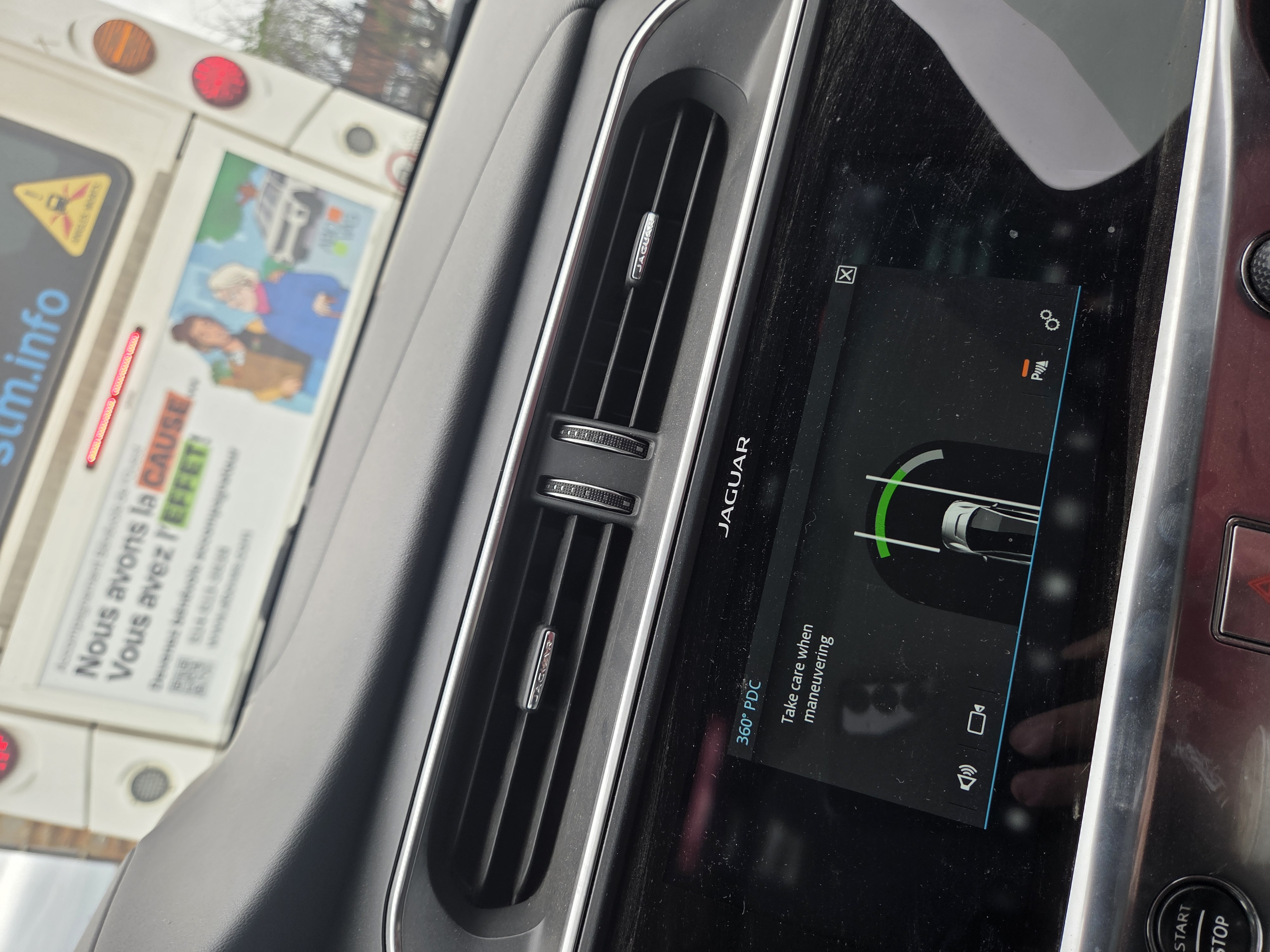
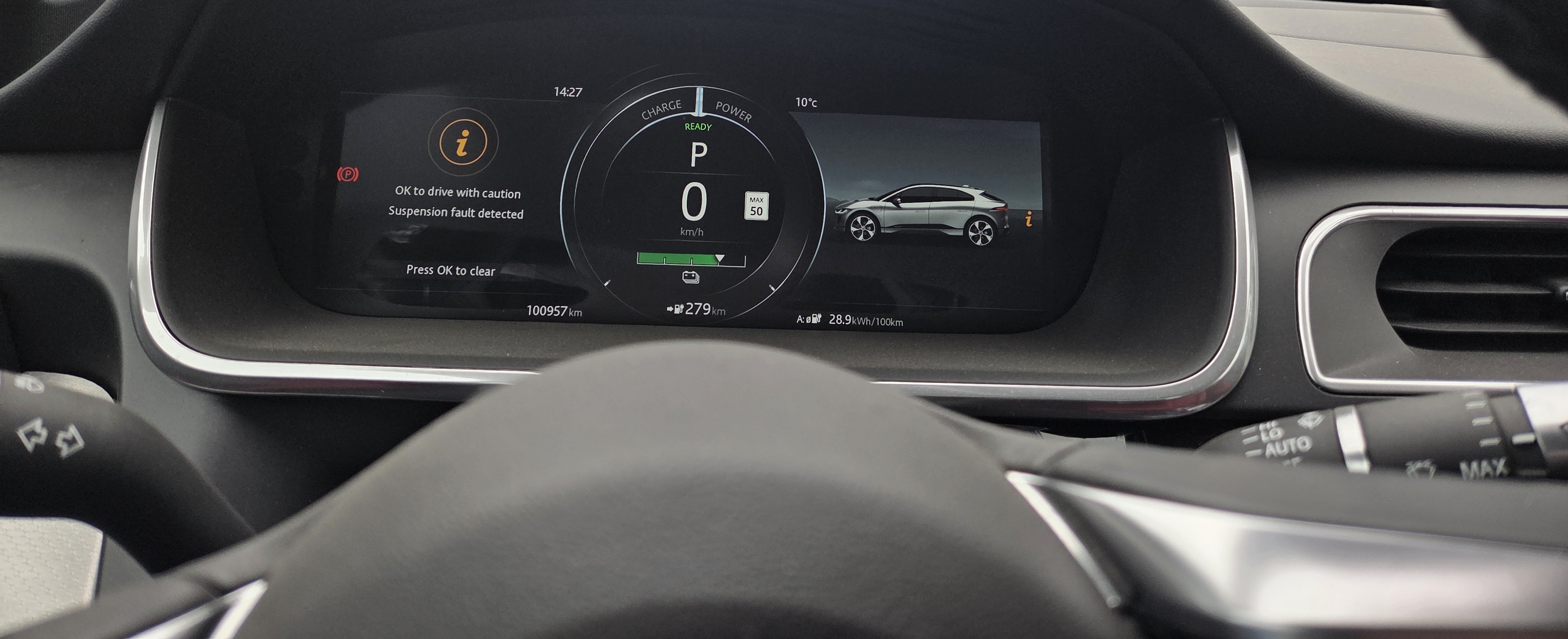
Post-repair developments observed at and after vehicle pickup on 30 April 2026 (documented in the owner's escalation correspondence dated 4 May 2026 to the manufacturer's customer relations office; the absence of these specific symptoms prior to pickup is supported by the dealer's own prior repair orders from both documented service visits — R.O. cashiered 29 September 2025 and R.O. opened 12 November 2025 — neither of which records any of the post-pickup observations listed below): The original traction battery fault warning was reported as remaining active upon vehicle pickup. A new suspension fault warning was reported as appearing immediately upon pickup (not recorded in either prior R.O.). The infotainment system was reported as malfunctioning, with symptoms including screen flickering during driving, random alerts appearing without input, the auto-parking interface activating while the vehicle was stationary, and the screen subsequently going black and non-functional (none of these infotainment behaviors are recorded in either prior R.O.). Steering wheel controls (buttons and switches on the wheel itself, distinct from the rack-and-pinion mechanical issue noted above) were reported as intermittently unresponsive (not recorded in either prior R.O.). Unusual electrical/mechanical noises were reported from behind the dashboard at pickup (not recorded in either prior R.O.). Battery range was reported as inconsistent with expected levels.
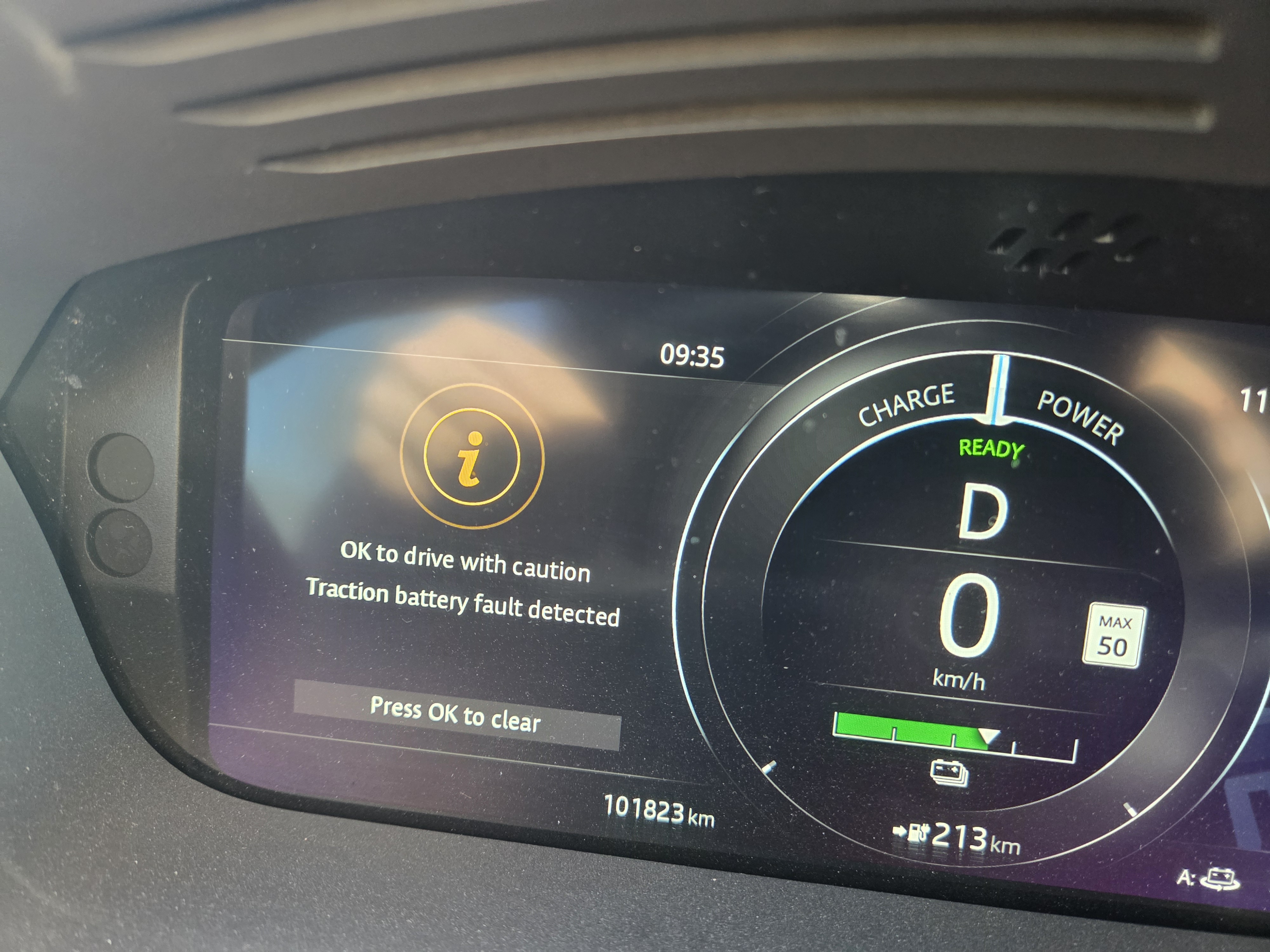
Post-repair fault recurrence (12 May 2026): Approximately 12 days after vehicle release from the November 2025 through April 2026 warranty repair, the traction battery fault warning displayed on the instrument cluster (PHOTO-003), with odometer reading 101,823 km — approximately 866 km of driving since pickup. The owner returned the vehicle to a manufacturer-authorized service location on the same date; a rental vehicle was authorized within two days.
Documented resolution
August 2025 visit, customer-pay invoice total CA$2,448.17 (paid via INTERAC), broken down by concern: traction battery fault diagnostic (CA$1,541.80), 12V battery replacement labor (CA$235.00), and power steering software update and rack mechanical failure diagnostic (CA$352.50). Battery energy control module software update applied to address P1B48-00.
November 2025 through April 2026 service event, customer-pay invoice total CA$2,365.67: High-voltage traction battery system work (module replacement, sublet welding, harness replacement) was warranty-covered at CA$0.00. The second 12V auxiliary battery replacement and Power Supply Distribution Box replacement were billed customer-pay and make up this visit's invoice total.
Power steering rack (separate concurrent issue): The August 2025 diagnostic (CA$352.50, included in that visit's invoice total above) was customer-pay because the manufacturer warranty for this component had already expired (vehicle past the 60,000 km warranty mileage threshold). This is a procedural out-of-warranty determination, distinct from the contested warranty extension requests addressed below. The rack and pinion replacement itself was customer-authorized in March 2026 but, per owner statement, has not been completed. No invoice for the replacement work exists or has been settled. The replacement is not warranty-covered.
Resolution of the traction battery matter is contested. Following the warranty repair, the owner submitted formal escalation correspondence dated 4 May 2026 to the manufacturer's customer relations office requesting (among other items) a warranty extension equivalent to the out-of-service period, restoration of paid connected services for the same period, written confirmation that the vehicle is safe to operate under current recall conditions, immediate safety-critical priority re-evaluation, and consideration of replacement or buyback. The reply dated 5 May 2026 from a manufacturer representative acknowledged the case, confirmed that safety recall H570 was active on the vehicle (with H572 stated as 'not yet in effect'), referred non-recall technical concerns to the local retailer, and stated that a case would be opened to follow the vehicle repair at the retailer level. The warranty extension, connected services extension, safety confirmation, replacement, and buyback requests were not directly addressed in the reply. The owner has also filed a Safety Defect Confirmation with Transport Canada in connection with this matter; the specific file number is not disclosed in this published case at the owner's editorial discretion.
EV Risk Index observation
Scope note: this case documents two distinct concurrent issues. The traction battery system fault is the primary subject of the dispute. The power steering rack mechanical failure is a separate, unrelated component issue — out of warranty by mileage at the time of diagnosis, with the replacement work customer-authorized but not completed — and is documented here for completeness, not as part of the contested matter.
On the traction battery matter: the August 2025 diagnostic work addressing the same DTC category (P1B48-00) was customer-pay; the November 2025 repair for the recurrent fault was warranty-covered. The basis for the change in coverage status is not documented in the materials provided.
The auxiliary 12V battery required replacement twice within approximately three months — the relationship between these recurring failures and the traction battery system is not documented. No state-of-health reading or battery module production date was recorded in either visit. No assessment of recall applicability was noted on either dealer invoice, despite later manufacturer correspondence confirming that safety recall H570 was active on the vehicle.
The post-pickup symptoms documented in the photographs and the owner's 4 May 2026 escalation correspondence — new suspension fault warning, infotainment malfunctions, unresponsive steering-wheel buttons, dashboard-area noises — are not recorded in either of the dealer's prior repair orders covering the two service visits described above. This documentary sequence (absent in prior R.O.s, present at pickup) is supported by the dealer's own service records and is independent of the owner's narrative.
The owner's documented escalation requests to the manufacturer — warranty extension equivalent to out-of-service period, paid connected services extension, written safety confirmation, replacement, and buyback consideration — were not directly addressed in the manufacturer's reply correspondence. The reply referred non-recall technical concerns to the local retailer.
Mileage record discrepancy (owner-asserted): The original service dealership's repair order records vehicle odometer as 125,253 km at intake on 26 August 2025. The subsequent service dealership's repair order records vehicle odometer as 100,935 km at intake on 12 November 2025 — a difference of approximately 24,318 km between the two dealers' records within roughly 11 weeks. Owner-submitted post-repair photographs (PHOTO-002 and PHOTO-003) show dashboard odometer readings of 100,957 km and 101,823 km respectively, internally consistent with the second dealer's record. The owner has stated the original dealer's figure is a data-entry error and that the actual vehicle mileage at the first service visit was approximately 100,000 km. The owner has indicated correction of the original service record is pending the owner's return visit to that dealership; the second service dealership is independently aware of the discrepancy. EVRI documents this discrepancy as an owner-asserted issue and does not adjudicate which dealer's figure is correct. The discrepancy is documented as a finding because vehicle odometer accuracy on dealer service records is a documented factor in manufacturer warranty mileage thresholds and vehicle history reporting; significant discrepancies in dealer-entered odometer values are a documented owner-protection issue across the industry.
Manufacturer responses to owner requests
- Owner request
- Extension of manufacturer warranty by approximately 6 months equivalent to the period the vehicle was out of service for warranty repair (November 2025 through April 2026).
- Outcome
- Request not addressed in correspondence
- Documented basis
- Submitted in formal escalation email dated 4 May 2026 to the manufacturer's customer relations office. The reply dated 5 May 2026 from a manufacturer representative acknowledged the case and stated a case would be opened to follow the vehicle repair at the retailer level, but did not include a substantive response to the warranty extension request. Earlier correspondence from the same office dated 15 April 2026 had stated the office was 'unable to provide any further information on this matter' and referred technical inquiries to the local retailer.
- Owner request
- Extension of paid connected services subscription by approximately 6 months equivalent to the period the vehicle was out of service for warranty repair.
- Outcome
- Request not addressed in correspondence
- Documented basis
- Submitted in the same 4 May 2026 escalation email. The 5 May 2026 reply did not include a substantive response to the connected services extension request.
- Owner request
- Written confirmation that the vehicle is safe to operate under current recall conditions, immediate re-evaluation under a safety-critical priority case, and consideration of replacement or buyback options.
- Outcome
- Partially addressed — recall status confirmed; safety confirmation and replacement/buyback not addressed
- Documented basis
- The 5 May 2026 reply confirmed that safety recall H570 was 'currently active' on the vehicle and that the local retailer could address it. The reply stated that H572 was 'not yet in effect.' The requests for written safety confirmation, safety-critical priority re-evaluation, and replacement or buyback consideration were not addressed; non-recall technical concerns were referred to the local retailer.
Help other owners
Submit your own case
Document your service event with an independent operational analysis. With your consent, your case can be published here — anonymized of dealer, location, and personal identifiers — to help other owners researching this vehicle.
Start your analysis →Documentary · Owner-grounded · Reversible
Swipe or use the buttons to browse cases. Final slide is how you submit your own.
Editorial assessment
The 2019 Jaguar I-PACE is one of the most instructive vehicles in the EV reliability landscape — not because it is unusually defective, but because it exemplifies how a premium EV can become a difficult ownership proposition after warranty expiration. The I-PACE entered the market as a genuinely ambitious product, and its early reviews reflected that. What followed was a sustained pattern of thermal-related recall campaigns affecting its high-voltage battery, compounded by manufacturer decisions that have thinned the certified-service footprint in North America.
Owner reports consistently describe post-repair charging or power limits that persist after recall work is completed. These limits are software-controlled and vary in severity, but they materially affect the ownership experience. Documentation is essential — the pattern of repeat service visits and unresolved limits is what qualifies owners to pursue regulatory escalation or, if applicable, class-action participation. Owners who have already obtained BMS logs and full service histories are in a stronger position than those who have not.
Depreciation compounds every other risk. Resale values have fallen substantially below comparable EVs, which means the trade-in-versus-repair calculation rarely favors keeping the vehicle once significant out-of-warranty work is required. Owners considering a repair expenditure over fifteen or twenty thousand dollars should first obtain a current wholesale valuation, because that number often exceeds the resale value itself.
Editor's take
Drive an I-PACE on a good road and you understand why people bought these in 2019. The chassis is sublime — genuinely one of the best-handling SUVs built in the last decade, regardless of powertrain. The interior has aged beautifully, the cabin stillness is otherworldly, and the acceleration is still quick enough to embarrass a lot of modern EVs. For about twenty minutes of driving, the I-PACE feels like the sort of car Jaguar should have been building all along.
Then you try to charge it on a road trip and the illusion collapses. A 100 kW maximum charging rate was competitive in 2019 and is genuinely inadequate in 2026. Combined with the software-imposed charging limits that affect post-recall vehicles, you're planning your day around charging stops the way Model 3 owners stopped having to in 2018. The vehicle rewards enthusiasts who drive locally and charge at home. It punishes anyone who tries to use it the way a modern EV should be usable.
Buy, lease, or walk away
Our take
Walk away
At current resale values, the 2019 I-PACE is genuinely tempting — you can find well-kept examples for $25,000-$30,000 and the original sticker was over $85,000. The problem is not the purchase price. The problem is what happens at year seven and beyond. A single significant out-of-warranty repair — say, a thermal-management module or a high-voltage contactor — can cost more than the vehicle is worth. Jaguar's contracting service network in North America means finding a shop that will even attempt certain repairs is increasingly difficult. Independent EV specialists sometimes take these on, but parts availability is becoming a real issue. For most buyers, the risk-adjusted value isn't there at any price.
Price guidance: Walk away unless the vehicle is under $20,000, has documented recent thermal-campaign completion, and you're in a market with a confirmed independent Jaguar/EV specialist shop.
This is editorial commentary based on depreciation data, warranty timing, and platform risk. Not financial advice — consult a qualified professional for significant purchase decisions.
Active recall campaigns
The following recall campaigns affect or have affected vehicles matching this make and model. Always verify with the regulator using your VIN.
Jaguar I-PACE battery thermal recall campaigns
Recall campaign codes on file for this vehicle
Manufacturer campaign code plus the NHTSA campaign number for every recall we have on file for this year and model. Always cross-check by VIN — open recalls vary between specific vehicles within the same model year.
| Mfr. code | NHTSA # | Year | Description |
|---|---|---|---|
| H570 | 25V057 | 2025 | High-voltage battery thermal overload; interim software cap at 90% SoC; 2019 vehicles subject to repurchase program |
| H514 | 24V633 | 2024 | Battery thermal overload follow-up; BECM software update following prior H441/H459/H471 repair |
| H471 | 24V085 | 2024 | Correction to prior recall repair on 2019-2020 I-PACE for thermal overload |
| H459 | 23V709 | 2023 | Expansion of H441 thermal overload campaign |
| H441 | 23V369 | 2023 | Initial voluntary safety recall for HV battery thermal overload, 2019-2024 I-PACE |
Verify by VIN with the regulator in your region:
Codes are updated at each content refresh; new campaigns may have been opened since the last update. Regulators outside of NHTSA typically use a vehicle-registration or VIN search flow rather than a per-model URL.
Jaguar I-PACE brake recall (2019)
Jaguar I-PACE electrical system recall (2019) - NHTSA 23V369000
Jaguar I-PACE electrical system recall (2019) - NHTSA 23V709000
Jaguar I-PACE electrical system recall (2019) - NHTSA 24V085000
Jaguar I-PACE electrical system recall (2019) - NHTSA 24V086000
Jaguar I-PACE electrical system recall (2019) - NHTSA 24V183000
Jaguar I-PACE electrical system recall (2019) - NHTSA 24V633000
Jaguar I-PACE electrical system recall (2019) - NHTSA 24V927000
Jaguar I-PACE seat recall (2020)
Jaguar I-PACE electrical system recall (2020)
Jaguar I-PACE electrical system recall (2021)
Jaguar I-PACE visibility recall (2021)
Jaguar I-PACE lighting recall (2021)
Help other owners — file with the regulator early
Regulatory complaints to NHTSA, Transport Canada, DVSA, and other authorities feed national defect databases. Each report contributes to pattern detection that can trigger formal investigations and recalls — protecting other owners of the same vehicle, not just you.
You can file a regulatory complaint at any time, even before contacting your manufacturer or dealer. The regulatory complaint is a separate channel that helps every owner of your vehicle.
Jaguar risk scores over time
Every Jaguar vehicle we rate, plotted by model year. Lower scores indicate lower reliability risk.
- This vehicle — the 2019 I-PACE you're viewing
- Low risk — failure index 0–30
- Moderate risk — failure index 31–60
- High risk — failure index 61–100
Data points: 2019 I-PACE: 85, 2020 I-PACE: 82, 2021 I-PACE: 78, 2022 I-PACE: 75, 2023 I-PACE: 72, 2024 I-PACE: 68.
Jaguar I-PACE — risk by model year
Scores shift year to year with recalls, battery packs, and platform maturity. Compare every Jaguar I-PACE model year we rate:
- Jaguar I-PACE 2020 82/100
- Jaguar I-PACE 2021 78/100
- Jaguar I-PACE 2022 75/100
- Jaguar I-PACE 2023 72/100
- Jaguar I-PACE 2024 68/100
How this rating has changed
Each month we re-rate this vehicle against the latest recall, complaint, and repair data. Here is how its score has moved.
Since Jun '26, this vehicle's rating is unchanged (85 → 85 out of 100).
- Jun '26: 85/100
- Jul '26: 85/100
What the score means
A failure index of 85/100 places this vehicle in our critical risk band. Vehicles in this band have multiple concerning factors. Appropriate only for buyers who understand they may face significant out-of-warranty costs.
See our full six-factor methodology for how this score is calculated.
Verify with your regulator
The regulator in your jurisdiction is always the authoritative source for whether your specific VIN is affected by an open safety campaign. Check the database below using your vehicle identification number.
- United States — NHTSA (US)
- Canada — Transport Canada
- United Kingdom — DVSA
- European Union — EU Safety Gate (RAPEX)
- Germany — KBA
- France — Rappel Conso
Before you buy or sign — what to verify
Our risk rating is a category-level assessment based on platform, chemistry, supplier, and documented recall history. It is not an assessment of any specific vehicle you are considering. Individual vehicle condition varies substantially based on factors outside the manufacturer's control — and those owner-side factors often matter more than the platform rating.
Owner behavior matters more than most people realize
Two identical 2019 Jaguar I-PACEs can be in dramatically different condition at the same odometer reading. The variables that matter most:
- Driving style. Hard acceleration, aggressive braking, and high-speed cornering accelerate wear on battery cells, suspension components, tires, and brake systems. An owner who regularly uses full regenerative braking without balancing with normal friction braking will wear rotors differently than a smooth driver — and neither is the manufacturer's fault.
- Charging habits. Routine DC fast-charging to 100% on NMC or NCA battery chemistry accelerates degradation materially. An LFP-equipped variant charged daily to 100% is fine; an NCA Long Range variant charged that way is not. Charging habits over three or four years can make a 20-point difference in effective battery health between otherwise identical vehicles.
- Climate exposure. Vehicles kept in garages last dramatically longer than those parked outdoors in extreme climates. Salt exposure on coastal routes or heavily salted winter roads accelerates corrosion of undercarriage components regardless of manufacturer.
- Scheduled maintenance. Manufacturers publish specific inspection requirements — typically every 12-24 months — that are conditions of full warranty coverage. Owners who skip these inspections may have valid warranty claims denied, which is not the manufacturer failing the owner but the reverse.
The pre-purchase inspection checklist
Before buying any used EV — especially one in our Moderate, High, or Critical risk bands — commission a pre-purchase inspection from a qualified EV technician. Not a general mechanic, not the dealer selling the vehicle, not a friend with tools. A technician with documented EV service experience.
The inspection should include at minimum:
- Battery state-of-health diagnostic scan. Every major EV platform exposes battery SOC and capacity data through the OBD2 port or manufacturer diagnostic tools. A three-year-old vehicle should retain 90%+ of original capacity; a five-year-old should retain 85%+. Substantially worse numbers indicate either platform issues or abuse.
- Tire condition and wear pattern analysis. Uneven wear indicates alignment issues or aggressive cornering. Mismatched tire brands or sizes across axles indicates the owner cut corners on replacement. Season-inappropriate tires (summer tires year-round, worn-out all-seasons in snow regions) indicate poor upkeep broadly. Tire tread depth and rotation history are among the most reliable diagnostics of overall owner care — a well-maintained vehicle almost always has well-maintained tires.
- Service record review. Ask for complete service history. Dealer-stamped maintenance logs, software update records, and any warranty claims filed. Gaps in the service history matter. Multiple address changes in the service records may indicate the vehicle traveled between owners faster than typical — worth investigating why.
- Visual inspection for signs of abuse. Undercarriage damage, curb rash, curb-struck wheels, aftermarket modifications without documentation, and signs of collision repair not disclosed by the seller.
- Recall campaign completion verification. Run the specific VIN through the regulator databases linked above. Every applicable recall campaign should show "remedy completed" status. If campaigns are outstanding, get them completed before taking possession — campaigns that were not completed by the previous owner may transfer to you as the new registered owner.
Manufacturer maintenance requirements matter for warranty
EV manufacturers typically require specific inspections at defined intervals — often every 12 or 24 months — as a condition of full warranty coverage. These include brake fluid changes, cabin filter replacements, coolant system inspections, tire rotations, and software updates. Owners who neglect these requirements may have warranty claims denied even for issues entirely unrelated to the neglected item.
Check the specific owner's manual for your Jaguar I-PACE to understand what inspections are required and when. A vehicle with a complete documented inspection history is measurably more valuable — and lower risk — than an otherwise identical vehicle without maintenance records. When buying used, verify the service history yourself with the manufacturer's dealer network; don't rely solely on what the seller tells you.
What this rating means, specifically
A high failure index score indicates that the category of vehicle (this model, this year, this platform) carries elevated risk relative to alternatives. It does not mean any specific 2019 Jaguar I-PACE you encounter will fail. Conversely, a low failure index score does not guarantee a specific well-maintained vehicle is risk-free — a neglected low-risk vehicle can easily be worse than a well-maintained high-risk vehicle.
The rating is a starting point for due diligence, not a substitute for it.
This rating is an editorial assessment based on publicly available data and is not a safety rating, reliability guarantee, or buying recommendation. Individual vehicle condition varies substantially based on owner maintenance, driving style, charging habits, and environmental exposure. A high risk score does not predict failure of any specific vehicle, and a low risk score does not guarantee reliability. Always commission a pre-purchase inspection from a qualified EV technician, verify recall completion through the manufacturer and relevant regulator, and review complete service history before any significant purchase decision.